Retrieval Augmented Generation (RAG) for PLM Systems: Architecture, Use Cases, and Maturity
ByIlan Madjar
In this post, Ilan Madjar explores how Retrieval Augmented Generation (RAG) can be applied to PLM environments to populate generative AI in enterprise system data and support an Agentic AI approach in the organization. The article breaks down the technical architecture behind RAG, explains how it differs from execution-focused approaches like MCP (model context protocol), and outlines practical PLM use cases and maturity stages.
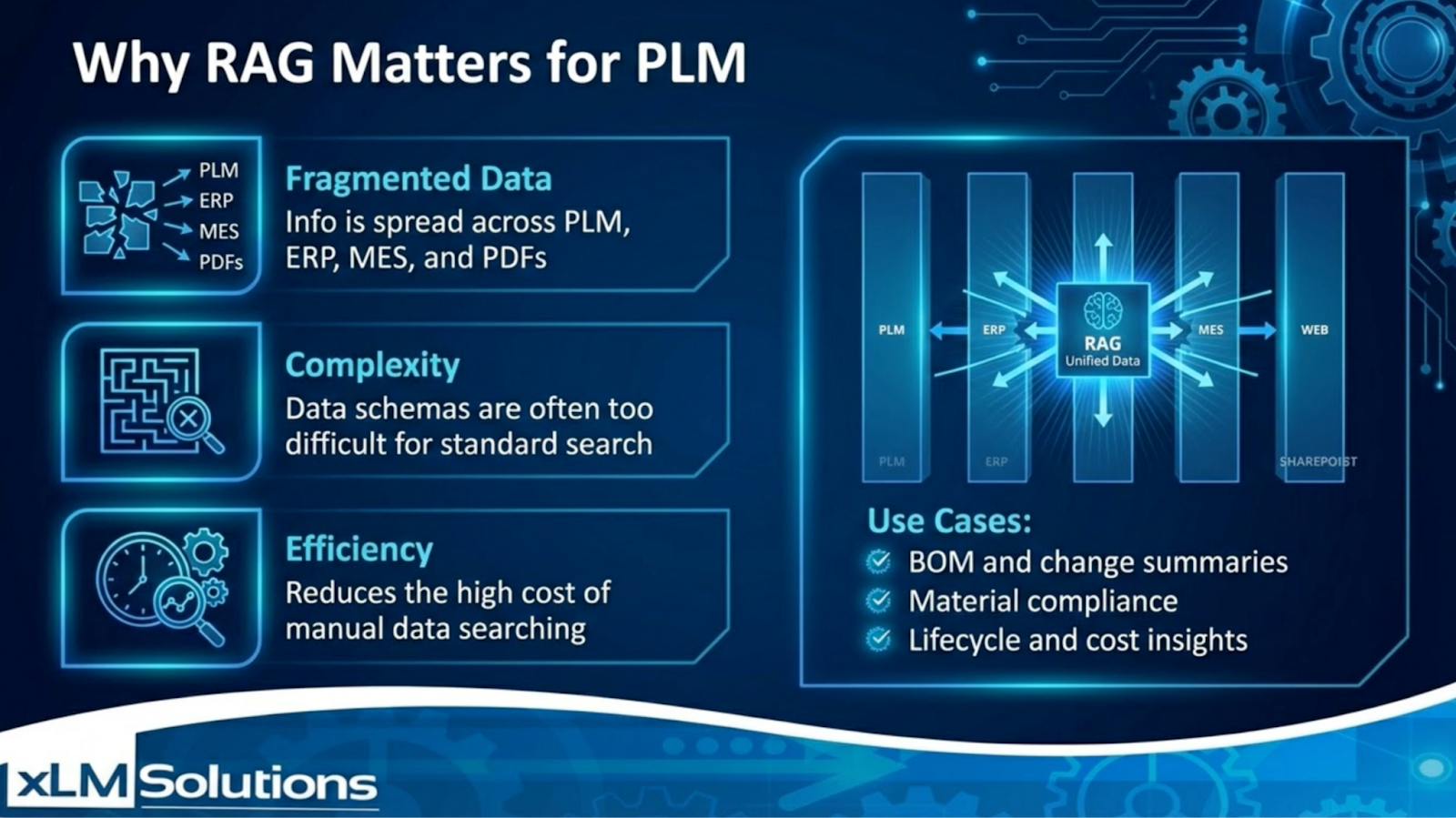
Generative AI is increasingly being evaluated for use in PLM environments, but applying large language models directly to engineering and manufacturing data presents well-known challenges. PLM information is fragmented across systems, governed by complex schemas, and heavily dependent on context such as revision, state, and effectivity. Without grounding, AI systems produce responses that may be fluent but unreliable. Retrieval Augmented Generation (RAG) addresses this problem by anchoring AI responses in enterprise system data. To see RAG at work, view our live demo on YouTube. In this post, I’ll outline what RAG is in the context of PLM systems, how it differs from Model Context Protocol (MCP), and the technical foundation required to implement it in a practical, vendor-neutral way.
What is RAG for PLM?
RAG combines semantic retrieval with generative AI at runtime. Instead of prompting a language model directly, RAG introduces an intermediate retrieval step that pulls preprocessed relevant content from enterprise data sources. The retrieved content is then passed to the model as grounded context for response generation (this is similar to populating a structured dictionary database). In PLM environments, this means answers are based on:- Actual BOM structures
- Real change descriptions
- Verified ERP and PLM records
- Associated metadata such as part number, revision and lifecycle state
RAG vs. MCP: Different Problems, Same Runtime
It is important to distinguish RAG from Model Context Protocol (MCP).- RAG focuses on knowledge retrieval from existing data sources, typically static or semi-static
- MCP focuses on execution — how a model accesses, updates, or acts on live systems through workflows and APIs, although MCP can also be used for live data retrieval as we have shown in our previous demo in the series.
Why RAG Matters for PLM Data
PLM data rarely exists in a single system. Relevant information is typically distributed across:- PLM and PDM platforms
- ERP and MES systems
- PDFs, change documents, and specifications stored in sites like sharepoint, etc..
- BOM exploration and summarization
- Engineering change summaries
- Cross-system context retrieval (PLM + ERP)
- Reduction in time spent manually locating related data
Technical Foundation: Vectors, Embeddings, and Metadata
At the core of RAG are embeddings — numerical representations of semantic meaning. Textual PLM fields such as material descriptions or change reasons are converted into vectors. These vectors are stored in a vector database, enabling similarity-based retrieval rather than keyword matching. In the demonstrated architecture:- Structured PLM objects (e.g., BOMs) remain structured
- Text fields are embedded for semantic search
- Attributes such as revision and state are stored as metadata
- Retrieval respects object identity and lifecycle context
Vendor-Neutral Architecture
The RAG approach demonstrated is intentionally vendor-neutral. It works with:- Any PLM, PDM, or ERP system
- Any vector database
- Any LLM
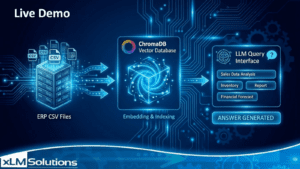
The RAG Process: Ingestion, Retrieval, Generation
RAG consists of three phases:- Ingestion: Data is parsed and preprocessed, relevant fields are selected, metadata is preserved, and embeddings are generated implicitly for relevant fields.
- Retrieval: User queries matched against vectors in the database by the LLM to retrieve semantically relevant content.
- Generation: The language model generates responses grounded in the retrieved data.
PLM RAG Maturity Model
RAG adoption in PLM environments typically progresses through stages:- Search assist
- Q&A over PLM and ERP data
- Contextual insights
- Cross-system intelligence
- Agent-assisted decision support