The Strategic Blueprint for Manufacturing AI: Why the “Harness Architecture” Wins
ByxLM Solutions
As manufacturers evaluate how to deploy AI across engineering, PLM, and operational workflows, the architecture they choose today will determine the flexibility, accuracy, and scalability of their future initiatives. In this blog, Ilan Madjar examines why harness-based, multi-agent AI frameworks offer a more practical and future-proof path than custom model training for most manufacturing organizations.
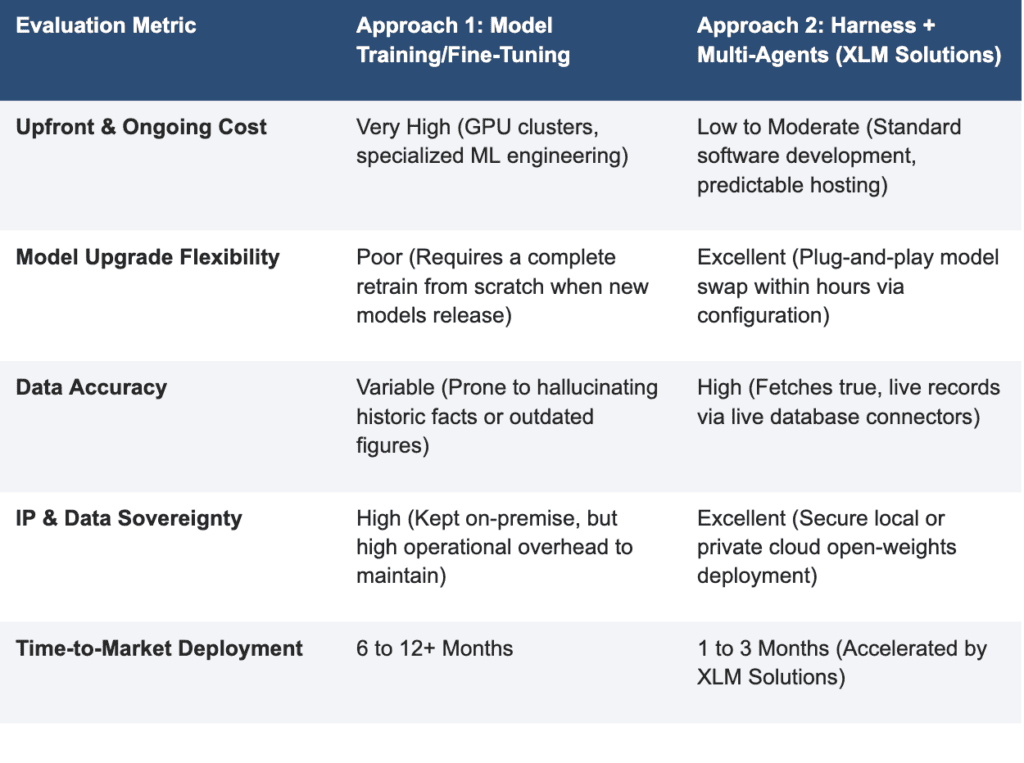
Modern manufacturing enterprises stand at a multi-million dollar crossroads when evaluating artificial intelligence for Engineering Change Requests / Orders / Notices (ECRs / ECOs / ECNs), inventory coordination, and lifecycle tracking. The decision fundamentally boils down to two options for the AI approach.
- Approach 1 (Model Training/Fine-Tuning), which permanently alters an AI model's internal weights with historical data
- Approach 2 (Model Harnessing & Multi-Agent Architecture), which keeps a highly powerful foundation model completely frozen while surrounding it with an intelligent application framework.
The Core Imperative: IP, Data Sovereignty, and Avoiding Vendor Lock-In
When executing an enterprise AI strategy, building your own custom-tailored agentic harness is a vital necessity to protect your business intellectual property (IP). Though, relying blindly on closed, off-the-shelf vendor AI software introduces severe vendor lock-in, subordinating your core engineering and manufacturing workflows to external licensing models, volatile API pricing, and unpredictable software roadmaps. What if you want to switch to another vendor in the future? How do you move your tribal knowledge and AI memory? For example, let’s say you build an AI approach on Microsoft’s Co-Pilot. How easy will it be to switch to a different platform in the future? Furthermore, your data represents your primary competitive advantage including proprietary CAD metadata, complex material tolerances, historical supplier failure rates, etc. Consuming public cloud-based vendor AI solutions threatens your intellectual property and compromises strict data sovereignty boundaries. By engineering your own custom harness framework running local open-weight models (like Llama 3) in a private environment which could be hosted on the cloud (i.e. in AWS or Azure) or on-premise infrastructure you retain complete sovereignty. Sensitive manufacturing records stay safely locked within access-controlled local databases, to formulate responses and immediately discarded to eliminate external data bleed.Deconstructing the Architecture: What is an AI Harness?
To successfully deploy artificial intelligence on the factory floor or within PLM systems, organizations must understand the core infrastructure of what an AI harness is.. An AI Harness is a raw AI model based merely on a massive mathematical file of frozen neural weights(to the point it was last trained). On its own, it has no native interface to read an engineering schematic, query an SQL database, check stock levels, or enforce corporate security guardrails. The AI Harness is the robust software scaffolding built around that core model to make it operational, converting raw enterprise data into actionable insights.The Manufacturing Analogy: The Physical Wire Harness
To visualize this, think of a raw AI model as a high-performance Engine Control Unit (ECU) or a high-speed central processor in a modern vehicle. By itself, sitting unattached on a laboratory bench, that advanced processor is completely powerless. It cannot throttle the engine, read exhaust sensors, monitor transmission fluid, or display diagnostic alerts to the operator. The AI Harness acts exactly like the physical Wire Harness woven throughout an aircraft fuselage or automotive chassis. The physical wire harness is the vital, highly organized network of electrical cables, specialized bundles, structural terminals, and secure connectors that bridges the central processor to every critical component. It channels raw analog sensor signals from the brakes and fuel tanks, routes complex data streams across distinct sub-systems, blocks electromagnetic interference through protective sheathing (security guardrails), and pipes operational commands safely to physical actuators. In exactly the same way, AI Harness provides the structural data pipelines, memory management, and integration scaffolding required to connect a detached foundation model to live corporate ecosystems. Without a robust harness, your AI model remains an isolated processor on a bench, with it, it becomes an integrated, highly adaptive command center.Why the Harness is the Definitive AI Strategy
A Harness-driven approach combined with a Multi-Agent architecture represents the premier framework for industrial enterprise deployment. Instead of forcing a single model to natively memorize technical data (super costly training approach that is only good to the point of time the model was last trained on the data), the Harness fragments complex business logic among specialized digital workers, or 'Agents'. These agents leverage the standardized Model Context Protocol (MCP), acting like a universal open-source USB port for AI to connect directly to ERP, PLM, and scheduling platforms without brittle, custom-coded APIs. Alongside skills and other technologies to define the workflow, reduce tokenization and engineer contexts this is the optimal solution. This results in a completely future-proof, highly agile system. Because the corporate integration logic lives within the independent Harness rather than inside the model's weights, the underlying foundation model is entirely decoupled. If a faster, more accurate, or cheaper open-weight model is released next month, your IT department can swap it out within the harness in a short time without disrupting a single downstream connection or rewriting a line of database logic.Real-World Impact: The Bracket Swap Scenario
To demonstrate how this architecture functions in real-time, consider a daily operational engineering event: An engineer initiates an urgent Engineering Change Notice (ECN) to substitute a critical structural steel bracket with a newly designed aluminum bracket on an active assembly line.Execution via Approach 1 (The Custom Trained Model Failure)
The engineer queries a custom-trained model regarding the operational impact of the swap. Relying on historical neural configurations frozen during its last training cycle months ago, the model responds from memory, approving the alteration because it recalls ample aluminum material stock. However, it cannot know that a separate project completely consumed that physical stock two weeks ago. The line transitions, a stockout occurs, production stalls, and the company suffers immediate down-time losses. Upgrading this model later will force IT to re-ingest all history and re-run expensive training configurations from scratch.Execution via Approach 2 (The Harness + Multi-Agent Success)
The engineer submits the exact same inquiry to the Harness ecosystem. The framework immediately coordinates three specialized agents utilizing the Model Context Protocol (MCP):- Agent A (Engineering History Specialist): Queries the live PLM database via MCP to verify structural failure risk histories and stress tolerances for aluminum swaps.
- Agent B (Inventory Specialist): Queries the live ERP software, discovering actual physical stock is currently zero and flagging an automatic 14-day procurement lead time.
- Agent C (Project Management Specialist): Accesses live master schedules, flagging that a 14-day production delay will cause a critical bottleneck for a primary client shipment.
How To Overcome the Complexity Barrier
While the Harness and Multi-Agent method is the clear strategic choice, building the upfront orchestration logic, prompt pipelines, Skills and secure MCP connections requires deep PLM understanding as well as software engineering expertise. xLM Solutions removes this burden entirely, accelerating your deployment from long term to few months and even weeks:- Build Your Enterprise Harness: Assist your IT team in developing a production-ready software scaffolding tailored explicitly for engineering and manufacturing data structures, eliminating ground-up engineering cycles.
- Native PLM & ERP MCP Connectors: Assist in developing universal data pipelines connecting market-leading PLM (3DEXPERIENCE, SOLIDWORKS PDM, Autodesk Vault, OpenBOM, Aras) systems directly to your models.
- Custom Agent Blueprinting: Assist in configuring specialized digital roles to enforce compliance and automate administrative engineering tasks.
- Accelerated Deployment: Moving your ecosystem from concept to live production in just a few months.
 Conclusion: Harness Your Future