Reflections from CUSA 2026 in Reno
ByMarc Young
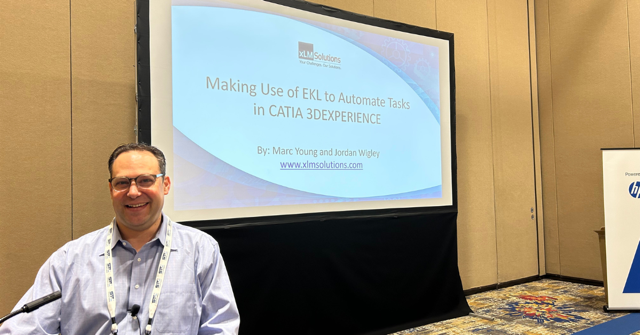
xLM’s Jordan Wigley and I were in Reno last week for the CATIA User Symposium Americas (CUSA) 2026, where we presented on using EKL to automate tasks in CATIA 3DEXPERIENCE. Here is what we took away from the event.
We had a very positive experience at CUSA 2026. The event brought together CATIA users from across the Americas for four days of sessions, workshops, and conversations at the Grand Sierra Resort in Reno. The program was broad, covering systems engineering, generative engineering AI, creative design, and simulation, but what stood out to us was the quality of the technical content and the maturity of the user community. These are practitioners who know the platform well and are asking detailed, substantive questions about where to go next. Here are our major takeaways from the week.
Generative AI Is a Priority for Dassault, and Users Are Thinking Carefully About It
Generative Engineering AI was clearly a central theme for this year's event. Dassault Systèmes has been investing heavily in this direction, and CUSA gave users a close look at what that means in practice across design, simulation, and systems engineering. Engineering is getting more complicated and connected from automotive, EVs, and aerospace to autonomous robots and large AI data centers. Dassault performed many live demos using complex data, highlighting everything from design kinematics and simulation. Some of the AI commands did not always function as expected, but Dassault acknowledged the demos were live; no videos and not yet released. They said most of the capabilities shown should be released by the end of the year. It was also interesting to hear how the attendees responded and the questions they asked. Attendees were not skeptical of AI, but they were thoughtful about it. The recurring concern was not whether the technology is impressive – it clearly is – but how it fits with what they have already built. How will it interact with existing governance structures? What does it require from the underlying data? What will it cost? These are the right questions. AI capabilities in a PLM environment depend on the quality and consistency of the data they work with. Organizations that have invested in getting their metadata, lifecycle states, and change processes into good shape are much better positioned to take advantage of what is coming.Systems Engineering and MBSE Are Gaining Ground
The systems engineering and MCSS track was well-represented this year, reflecting how seriously the CATIA community is taking model-based systems engineering. Sessions on MBSE practices and SysML v2 attracted strong participation, and the conversations around them felt grounded in real program challenges rather than theoretical discussion. This is consistent with what we see in our work. Customers who are managing complex, multi-discipline products are finding that getting the systems engineering layer right – requirements, architecture, interfaces – pays dividends throughout the development process. CUSA gave a good view of how teams across the Americas are approaching that challenge. This is especially true in DoD, now DoW-related, industries.Our Session: Making Use of EKL to Automate Tasks in CATIA 3DEXPERIENCE
xLM’s Jordan Wigley and I presented Session 1067 as part of the Design and Engineering track on Tuesday morning. Our goal was to answer a practical question: what is EKL actually useful for, and how do you decide whether a particular automation is worth building? Enterprise Knowledge Language (EKL) is Dassault's proprietary scripting language, built natively into CATIA and the 3DEXPERIENCE platform. It runs in both the rich client and on the server and is the primary mechanism for encoding business logic as rules, actions, and automated behaviors inside the platform. We walked through five use cases we see regularly in client implementations:- EIN and intelligent part numbering. When part numbers are typed manually, errors and inconsistencies accumulate over time. EKL allows you to define the numbering logic once, based on part attributes, and apply it consistently. We demonstrated a working EIN configuration and walked through how the rules are constructed.
- Drawing template automation. Applying the correct title block, updating drawing properties, and linking physical product attributes to drawing fields is work engineers do repeatedly. EKL handles most of this automatically on trigger.
- Material assignment. When a material is applied to a component, related properties often need to update as well. Rather than relying on engineers to follow up manually, EKL can propagate those changes automatically.
- CAGE code assignment. For organizations working with supplier data, EKL can read supplier attributes and assign CAGE codes without manual entry – a straightforward automation that reduces a common source of error.
- Data migration support. We use EKL regularly in migration projects to set and transform metadata during import workflows, particularly when bringing CATIA V5 data into a 3DEXPERIENCE environment where the data model differs.