3DEXPERIENCE World 2026: AI Is Arriving — Architecture Will Shape What Comes Next
ByMarc Young, Managing Partner, xLM Solutions
In this blog, Marc Young reflects on the introduction of Dassault’s new AI agents - Aura, Leo and Marie at 3DEXPERIENCE World 2026 and explores what lifecycle-embedded AI means for governance, integration and enterprise architecture.
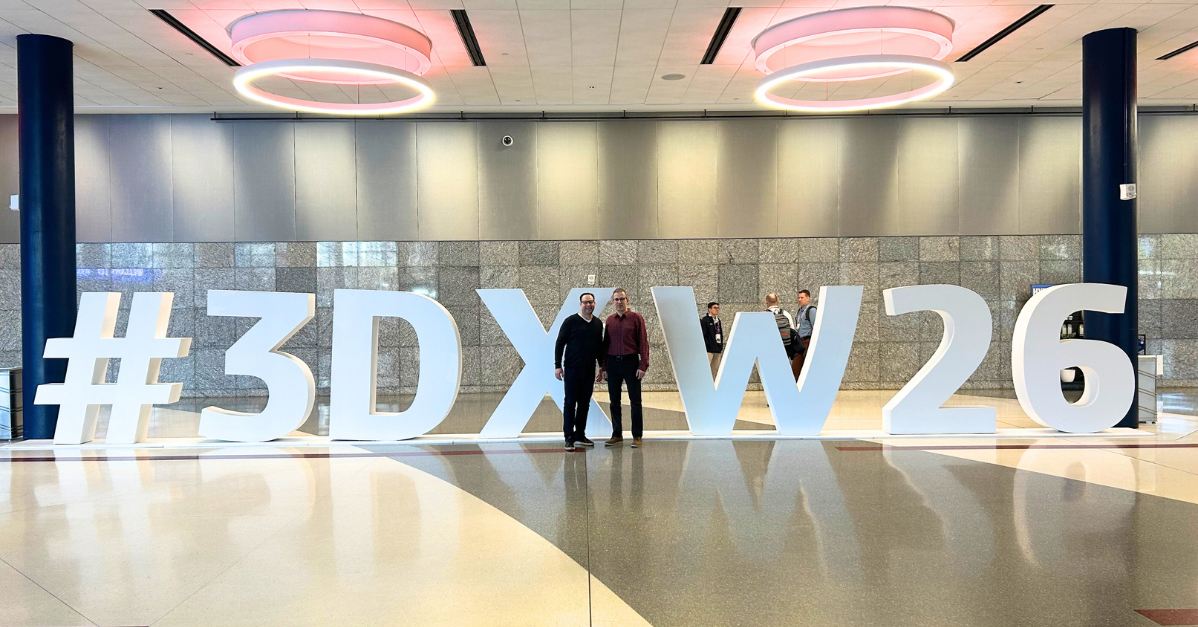
Ilan Madjar and I have been attending 3DEXPERIENCE World and SOLIDWORKS World before it for many years. As a Dassault Systèmes partner, we look to the event for perspective on how the platform is evolving and how customers are applying it in real environments.
This year in Houston, AI was clearly front and center most visibly through the introduction of Dassault Systèmes’ AI companions: Aura, Leo and Marie.
Rather than positioning AI as a separate capability, the focus was on how these companions operate within the lifecycle itself across requirements, engineering disciplines, materials and change management inside the 3DEXPERIENCE platform.
That framing is important. It suggests that AI in this ecosystem is being developed as part of the platform’s architecture, not alongside it.

What Aura, Leo and Marie Represent
Aura, Leo and Marie were presented with distinct focus areas:- Aura centers on orchestrating knowledge across requirements, projects and change. We see this mainly dealing with the ENOVIA, Governance technologies of Dassault and wider world wide web
- Leo supports engineering reasoning across mechanics, structures, motion, simulation and manufacturing. We see this mainly around the CAD tools such as SOLIDWORKS and CATIA and will handle generative CAD design (Generative AI)
- Marie focuses on materials intelligence, chemistry and regulatory context. We see this mainly around the BIOVIA and life science tools of Dassault
A Strategic Signal: Dassault and NVIDIA
Another moment that stood out was the on-stage discussion between Pascal Daloz and Jensen Huang. They framed the Dassault–NVIDIA relationship as a long-term, 20+ year collaboration that is now moving into a deeper phase. NVIDIA works broadly across the CAD and PLM ecosystem, but what was described here felt more specialized – centered on combining Dassault’s Virtual Twin capabilities with NVIDIA’s AI infrastructure to build what they referred to as industrial “universes”: full physical systems represented virtually at scale. That’s an ambitious and potentially very exciting direction. It raises important questions about how these architectures will be implemented, governed and deployed in real environments. There’s clearly more to learn, but it’s a development we’ll be watching closely.How Will This Apply To The Real World?
Considering we have seen cool demos such as building a CAD model based on human text inputs, the natural next question is: How will the AI help and actually work in the real world? We have questions such as:- How accurate will the AI be? Dassault Systèmes claims their AI is based on years of experience and knowledge they gained in the field along with your own data.
- How will your IP be protected? DS claims your data is not exposed to the “world.”
- What is the cost? We’ve seen very cool AI use cases, but I assume there will be a cost and licensing model behind them.
- Could AI at one point be more expensive than a human?
Our Masterclass: Enterprise Integration Framework (EIF)
Against that backdrop, Ilan and I were pleased to deliver our masterclass: 3DEXPERIENCE Enterprise Integration Framework: Integrating to Enterprise Systems. In this session, we provided practical examples of how the Enterprise Integration Framework (EIF) can be used to:- Extract structured data from the 3DEXPERIENCE platform
- Integrate with enterprise systems such as ERP
- Exchange SOLIDWORKS data managed on the 3DEXPERIENCE platform
- Preserve governance logic across connected systems